








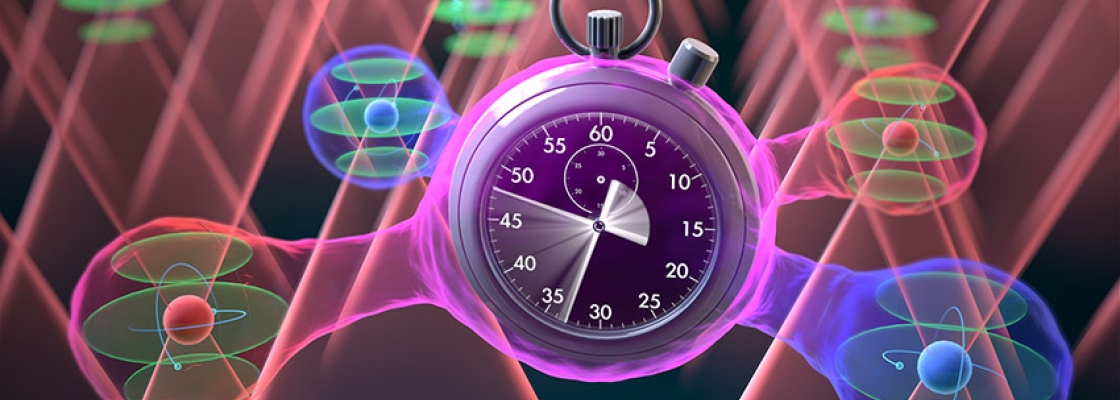
One of the scientific pursuits for which alkaline-earth atoms are most famous is optical atomic clocks. In atoms like Strontium and Ytterbium, there exists a long-lived optical transition known as the “clock transition”. Viewed as an oscillator, this transition has an intrinsic quality factor of in excess of 1017— that is, it can ring quadrillions of times before the oscillations die out. This means this oscillator can serve as an exceptional time-keeper, and, indeed, in the past decade, such optical atomic clocks have allowed some of the most precise measurements ever made by humans.
About the Kaufman Group

Our group applies the tools of atomic, molecular, and optical physics to the microscopic study and control of quantum systems, for applications in quantum simulation, quantum information, and metrology. We marry the tools of optical tweezer technology, Rydberg physics, quantum gas microscopy, and high precision spectroscopy to develop new directions in quantum information science.
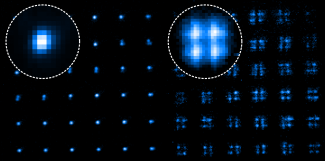
Towards these goals, we trap single alkaline-earth atoms in optical tweezer arrays, a powerful and effective technology that we demonstrated in 2018 for the first time. Optical tweezers allow precise single-particle control, the engineering of different forms of atomic interactions, and high-fidelity atom-resolved readout. However, while previous work with optical tweezers had focused on alkali atoms, the 2018 work opened the door to tweezer-based control of atoms with two electrons in their valence shell -- although a tiny addition, this additional electron gives rise to the rich internal structure of alkaline-earth atoms, which underlies their applications in metrology, quantum simulation, and quantum information. In this lab, we apply the microscopic control capabilities emerging from the optical tweezer toolset to the quantum science directions that emerge from the use of alkaline-earth atoms.
At the same time, we also are developing new experimental systems based on alkali-atomic systems, including cryogenic atom array project and a new experiment for reaching low temperatures in the Fermi-Hubbard model.
Research Areas
Another appealing aspect of alkaline-earth atoms is the presence of a second relatively narrow transition — though not as narrow as the clock transition — that can be used for ground-state laser cooling. This is especially powerful when combined with the possibility of rearranging optical tweezers to prepare arbitrary atomic distributions with very low entropy in the atomic spatial distribution. So far, large-scale demonstrations of atomic rearrangement have been used for spin models, with atoms that might be relatively hot in their motional degrees of freedom. In this project, we seek to prepare arbitrary distributions of scalable arrays of ground-state atoms for large scale itinerant models.
Starting with our demonstration of optical-tweezer trapping of Ytterbium-171, we have been exploring how this novel atom can be used for quantum computing, as well as for other directions in quantum simulation and metrology. The atom has a nuclear-spin of 1/2, which serves as a robust space for storing quantum information. At the same time, the presence of an optical clock transition and metastable enables key physical gadgets for mid-circuit measurement, two-qubit gates, and quantum error correction.
In the Spotlight

: Google Quantum AI Engages JILA Fellow Adam Kaufman to Lead New Neutral Atom Quantum Computing Effort
Read More
Google Quantum AI has named JILA Fellow Adam Kaufman to lead a new neutral atom quantum computing hardware team, marking a major expansion of its quantum research program. Kaufman will continue his research at JILA and CU Boulder, strengthening JILA’s leadership and impact in national and international quantum science.
Read More

: Assembling a superfluid from individual atoms
Read More
Since it was first proposed in 2004 by David Weiss and Maxim Olshanii, it has been a goal to see whether atomic rearrangement and high-fidelity ground-state laser cooling could employed to prepare superfluids and low-entropy many-body states of itinerant matter. In this work, we demonstrate such a protocol, opening a new path to assembling ground-state many-body state of bosonic and fermionic quantum systems.
Read More

: New proposal for using quantum error correction in metrology
Read More
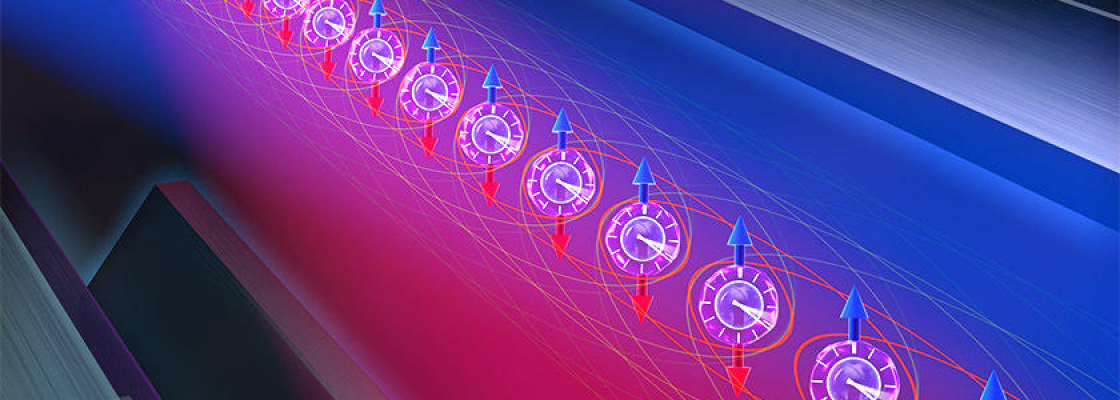
In quantum metrology, it has been considered for some time whether quantum error correction can be used to enhance precision measurements. Here, the primary challenge is devising codes ad protocols that correct noise while not correcting the unknown signal being sensed. In this collaboration with the Pichler, we identify some promising conditions for leveraging quantum error correction for enhanced sensing, even when signal and noise couple identically to sensor qubits.
Read More

: High-fidelity gates and creation of entangled states in Yb171 nuclear-spin qubits
Read More
Our paper on preparing entangled states in Yb171 has been accepted in Nature physics! Congratulations to the team! We show high-fidelity gates in the metastable qubit, high-fidelity three-outcome measurements, and coherent mapping of entangled states between the Rydberg, nuclear, and optical qubits. This work suggests several new directions, including in quantum error correction, hybrid digital-analog quantum simulations, and quantum metrology.
Read More
JILA Address
 We are located at JILA: A joint institute of NIST and the University of Colorado Boulder.
Map | JILA Phone: 303-492-7789 | Address: 440 UCB, Boulder, CO 80309