Home | Employment | Visitors | Members
Single Molecule Biophysics
The study of single molecules is revolutionizing biophysics. The Thomas Perkins group is interested in a wide range of biological questions such as: How do proteins move along DNA? How much force is generated by such a molecular motor? And, what is the spatial assembly of membrane proteins? To answer these questions, the Perkins group develops and uses precision single-molecule techniques such as optical traps and atomic force microscopy (AFM).
To look at molecular motors moving along DNA, the Perkins group developed a new optical-trapping microscope capable of resolving the smallest known step of a molecular motor, the 1-base pair (0.34 nm) step of along DNA. The group is now applying this technology to the study of (1) DNA-based molecular motors, (2) transcription factors, and (3) the folding and unfolding kinetics of RNA and RNA-protein complexes.
Following in JILA's tradition of precision measurements, the Perkins group improved the resolution of optical tweezers by increasing sensitivity and reducing instrumental noise. Improvements included the use of active stabilization of multiple types of laser noise, more stable optical design with improved laser-pointing stability, and active stabilization of microscope sample via an array of nanofabricated fiducial marks. With these enhancements, the Perkins lab measured and thereby stabilized an optical microscope to 0.1 nm in three dimensions (3D) over tens of seconds.
In addition to their biological application, precision measurements are revealing limitations in both our theoretical and experiment understanding of single molecule biophysical techniques. For instance, a careful study of DNA elasticity revealed that the persistence length (p) of DNA, a measure of DNA’s bending stiffness, appeared to depend on the length (L) of the DNA molecule, decreasing by as much as 18% for L = 632 nm. Yet, p is an intrinsic property of DNA that should be independent of L. To understand this conundrum, the Perkins group teamed up with theorists Meredith Betterton from the University of Colorado at Boulder and Philip Nelson from the University of Pennsylvania. This team showed that the limitations were not experimental in origin, but rather theoretical. This insight allows researchers to investigate short, stiff pieces of DNA without worrying about systematic errors in their force measurements.
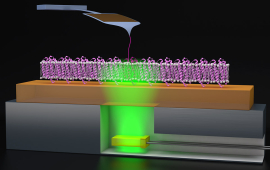
In a parallel effort, the group developed an ultrastable AFM that has atomic-scale stability and registration over tens of minutes at ambient conditions (in air at room temperature). In this work, optical-trapping techniques were applied to the AFM to detect and thereby stabilize the position of an AFM tip in 3D by scattering light off the apex of an AFM cantilever, not its back side. This new technique complements the traditional optical lever arm measurement of cantilever deflection. The resulting AFM is a hundred times more stable than the previous state-of-the-art AFM and capable of studying proteins in liquid at room temperature with Angstrom-scale stabilities and sensitivities over tens of minutes. The Perkins group is currently pursuing the application of this AFM to protein imaging as well as nanotechnology.