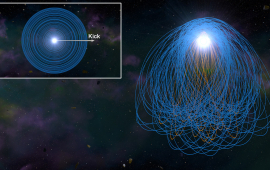
JILA astrophysicists investigate a broad range of topics including the evolution of stars, the formation of planets, the dynamics of black holes, and even the fundamental properties that give rise to the Universe itself.
JILA’s astrophysics research is aided by data gathered by ground- and space-based instruments. Our researchers use this astronomical data to test and refine theoretical simulations of processes that occur in our solar system and throughout the Universe.
Astrophysics
Researchers in Astrophysics
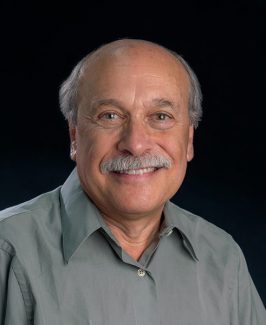 Mitchel C. Begelman
Focus: Astrophysical Gas Dynamics, Magnetohydrodynamics, Radiative Transfer Theory, Astrophysical Phenomena Role: Theorist
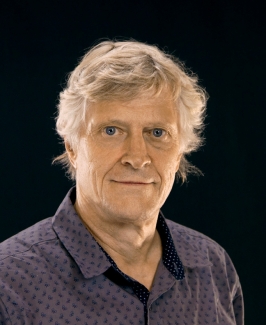 Andrew Hamilton
Focus: Black Holes, Galaxies, Cosmology Role: Theorist
 Ann-Marie Madigan
Focus: Stellar and gas dynamics near massive black holes, Solar systems and exoplanets Role: Theorist
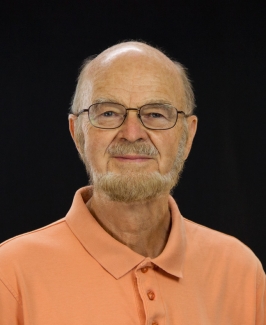 Juri Toomre
Focus: Structure & Evolution of Stars Role: Theorist
 Jason Dexter
Focus: Black hole accretion, radiative transfer, interferometry Role: Theorist
 Bryan Changala
Focus: Frequency combs, microwave spectroscopy, molecules, ions and radicals Role: Experimentalist
 Taeho Ryu
Focus: Multi-messenger Transients, Active Galactic Nuclei, Multi-body Dynamical Interactions, Gravitational Waves, Hot Jupiters, Stellar Binary Evolution Role: Theorist