Atomic & Molecular Physics

Assembling a superfluid from individual atoms

Teaser

Since it was first proposed in 2004 by David Weiss and Maxim Olshanii, it has been a goal to see whether atomic rearrangement and high-fidelity ground-state laser cooling could employed to prepare superfluids and low-entropy many-body states of itinerant matter. In this work, we demonstrate such a protocol, opening a new path to assembling ground-state many-body state of bosonic and fermionic quantum systems. 

New proposal for using quantum error correction in metrology

Teaser

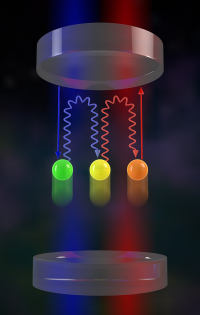
In quantum metrology, it has been considered for some time whether quantum error correction can be used to enhance precision measurements. Here, the primary challenge is devising codes ad protocols that correct noise while not correcting the unknown signal being sensed. In this collaboration with the Pichler, we identify some promising conditions for leveraging quantum error correction for enhanced sensing, even when signal and noise couple identically to sensor qubits. 

High-fidelity gates and creation of entangled states in Yb171 nuclear-spin qubits

Teaser

Our paper on preparing entangled states in Yb171 has been accepted in Nature physics! Congratulations to the team! We show high-fidelity gates in the metastable qubit, high-fidelity three-outcome measurements, and coherent mapping of entangled states between the Rydberg, nuclear, and optical qubits. This work suggests several new directions, including in quantum error correction, hybrid digital-analog quantum simulations, and quantum metrology. 

Micromechanical membranes can be quiet frequency sensors even at high amplitude

Teaser

Drum-like membrane resonators are intriguing for precision sensing because their resonance frequencies can be sensitive to a variety of parameters of interest, from mass to thermal radiation. The quest for improved sensitivity in tensioned membranes faces a tradeoff in which a high amplitude of mechanical motion improves signal-to-noise, but too high of a drive (beyond the so-called critical amplitude) introduces nonlinear effects.

In our work published in NanoLetters, we develop an experimentally straightforward method to evade this tradeoff. Using a patterned, trampoline-shaped membrane, we find that dual-mechanical-mode operation can bring these sensors to a thermally-limited frequency stability.  By measuring and correcting for frequency noise arising at high amplitude, we maintain this high stability when operating beyond the linear regime, opening new opportunities for membrane frequency sensing.