
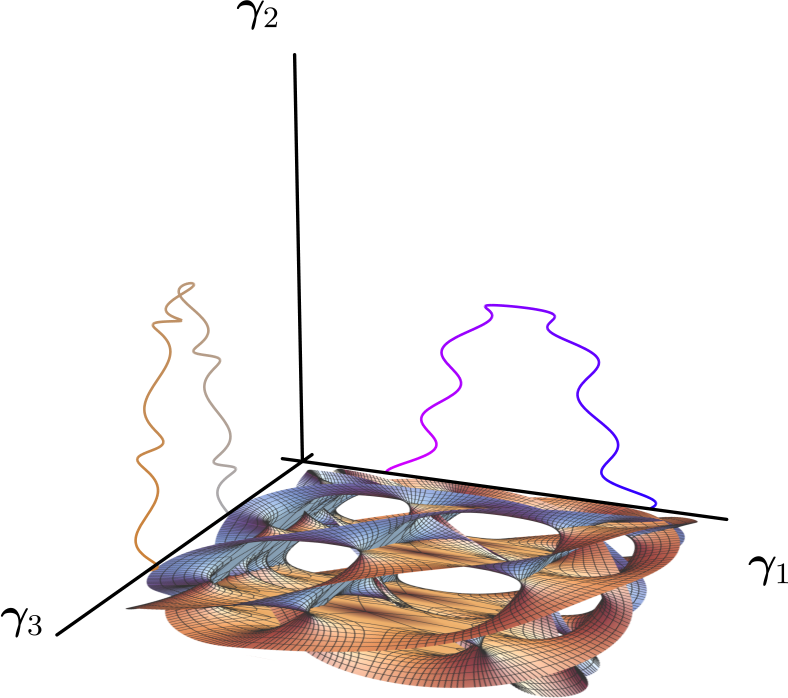
 Not
a direct product of internal and spacetime manifolds.
Not
a direct product of internal and spacetime manifolds.
Accomodates 10 internal and 3+1 large spacetime dimensions inside 11+1 dimensions.
The 4 weak vectors
\(\hat{\boldsymbol{\gamma}}^\pm_k\),
\(k = {\color{silver}{y}} , {\color{bronze}{z}} \),
Lorentz transform like Dirac vector \(\boldsymbol{\gamma}_3\).
The 6 color vectors
\(\hat{\boldsymbol{\gamma}}^\pm_k\),
\(k = {\color{red}{r}} , {\color{dgreen}{g}} , {\color{blue}{b}} \),
Lorentz transform like Dirac vector \(\boldsymbol{\gamma}_1\).
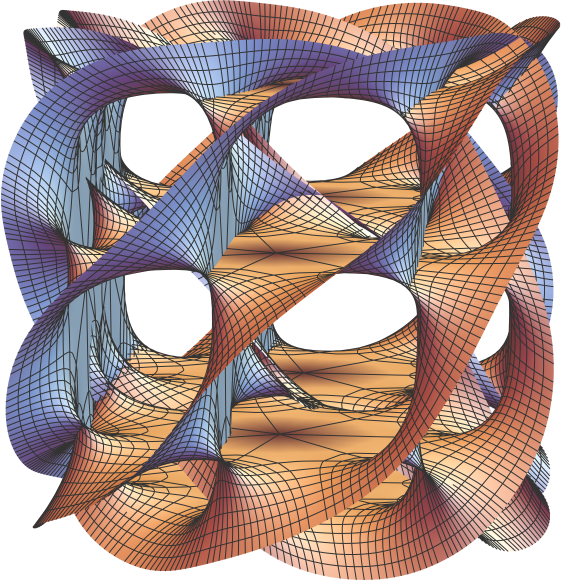 The 4 weak and 6 color vectors form a 10d compact complex manifold,
a D10-brane,
which carries the \(2^6\) spinors of \(\textrm{Spin}(11,1)\).
The internal complex structure is generated by the color pseudoscalar
\(I_{\color{red}{r}\color{dgreen}{g}\color{blue}{b}}\).
The 4 weak and 6 color vectors form a 10d compact complex manifold,
a D10-brane,
which carries the \(2^6\) spinors of \(\textrm{Spin}(11,1)\).
The internal complex structure is generated by the color pseudoscalar
\(I_{\color{red}{r}\color{dgreen}{g}\color{blue}{b}}\).
The weak and color gauge fields of the standard model are carried by bosonic open strings whose ends attach to D4 weak and D6 color subbranes of the fermionic D10-brane.
After symmetry breaking to the standard model (which is a subgroup of \(\textrm{SU}(5)\)), the compact internal fermionic D10-brane becomes a 10d Calabi-Yau five-fold. A Calabi-Yau \(n\)-fold is a complex manifold with \(\textrm{SU}(n)\) holonomy. A Calabi-Yau \(n\)-fold has the key property that it carries zero internal energy-momentum.
 8/15. Compactification from 26 to 12 dimensions on 14 dimensional SU(8)×SU(8) torus
